
Did You Know?
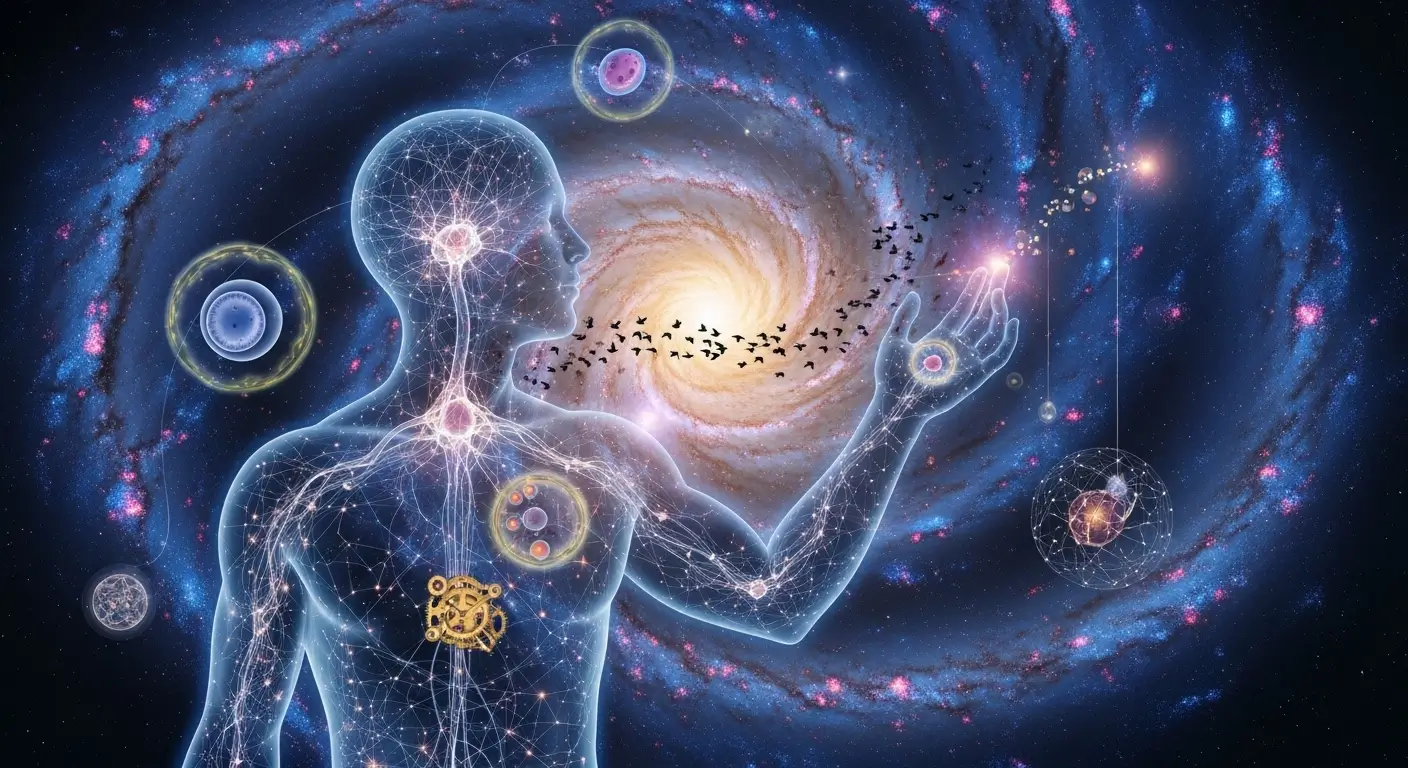
Did you know that the observable universe is approximately 93 billion light-years in diameter?
Interestingly, only 5 percent of the universe is viewed as regular matter.
Conversely, dark matter comprises 27 percent, and dark energy comprises 68 percent.
Notwithstanding, the human mind has difficulty comprehending the size of the universe.
Thus, perception determines the boundaries.
The Big Question of Cosmic Limits
Many people have questioned whether the universe has actual boundaries.
Interestingly, scientists are still puzzled by this question today.
Some models of the universe propose the existence of infinite space that cannot be viewed.
Conversely, other models propose that the universe is curved and has no boundaries.
Notwithstanding, the human mind seeks boundaries and closure.
What Science Says About the Universe
Modern physics examines space through mathematical calculations and observations.
Telescopes measure the patterns of cosmic background radiation.
Observations indicate that the universe is expanding at an increasing rate every year.
Furthermore, galaxies are moving away from each other at a rapid rate.
Notwithstanding, there is no scientific experiment that can detect the boundaries of the universe.
The Observable Universe vs. Reality
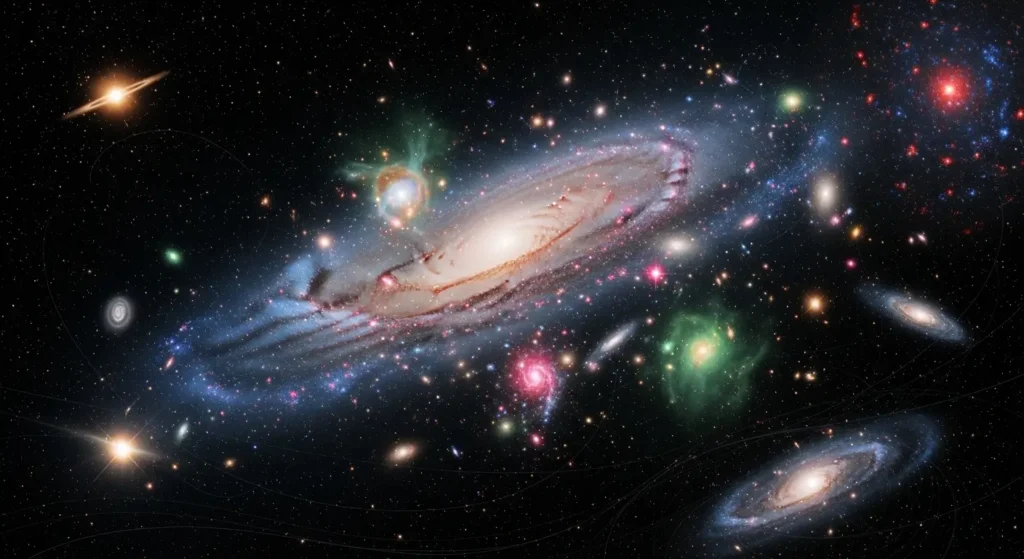
Only what reaches Earth as light is seen by humans.
The observable universe is the visible area.
But space can go on forever beyond the observable universe.
Yet, there is no way to prove the existence of unseen space.
So, boundaries may depend on technology, not reality.
Why the Human Brain Needs Boundaries
The human brain likes things to be clear and safe.
The brain experiences stress and discomfort when it is uncertain.
So, humans tend to create boundaries in their minds.
This need for boundaries is known as cognitive closure.
So, infinity is disturbing to many minds.
Psychology of Fear and the Unknown
Fear affects how humans understand space.
The unknown concept stimulates the fear response in the brain.
So, humans tend to simplify complex space concepts.
Boundaries make the mind feel secure.
So, boundaries in the mind give a sense of comfort.
Language Shapes Our Cosmic Perception
Language affects our conceptualization of the cosmos.
The word “edge” conveys the idea of physical boundaries.
But the universe may not have boundaries.
Language compels us to conceptualize abstract notions in human terms.
Thus, boundaries may exist only in language.
Historical Concepts of Cosmic Boundaries
The ancient world conceptualized the sky as a dome or a wall.
The early world of astronomy placed Earth at the center of the universe.
But discoveries overturned these concepts.
However, these concepts persist in our minds today.
Advances are often slower than our imagination.
Modern Cosmology Defies Human Scale
Distances in the cosmos defy human comprehension.
Light travels ninety trillion kilometers in a year.
Even nearby stars are beyond human reach.
Thus, due to their scale, humans use models.
Models are simplifications of reality for human understanding.
Do Limits Contain Observation Bias?
Observation requires instruments and a location.
Humans make observations on one planet.
Viewpoint constrains the observation of a huge space.
Thus, the results contain observation bias.
The truth may exist beyond observation.
Human Perception vs. Cosmic Truth
Human perception developed for survival, not cosmic study.
The human brain focuses on present survival and reward.
Infinity does not provide a survival benefit.
Thus, the human brain resists infinite ideas.
Limits provide benefit, not necessarily truth.
Psychology of Control and Meaning
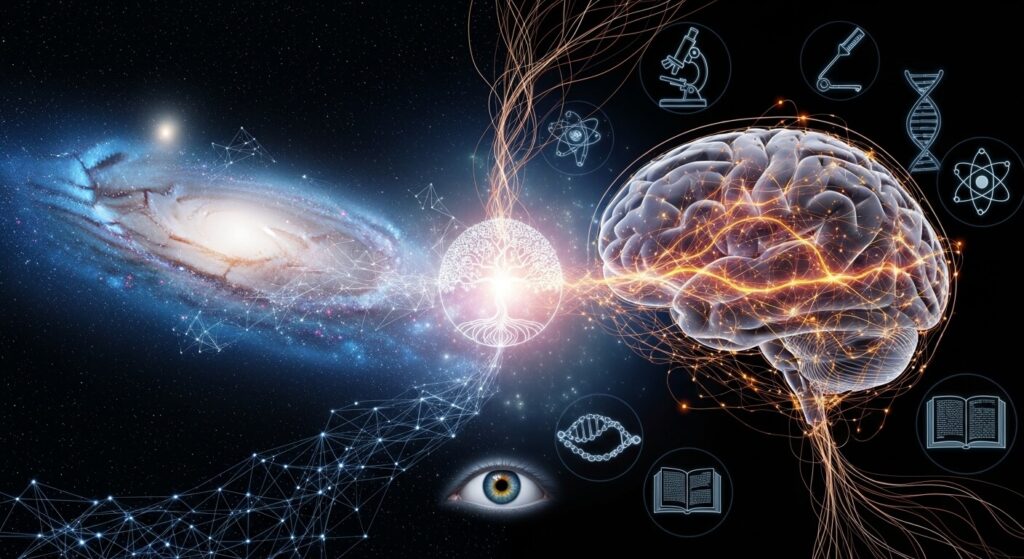
Human beings need control over their surroundings.
Limits provide a sense of control.
Cosmic limits imply understandable truth.
Without limits, truth lacks meaning.
Thus, human beings impose meaning on the universe.
Human Cognition and Pattern Seeking
Human brains are constantly on the lookout for patterns in everything.
Humans associate unrelated concepts to make sense out of things.
This trait enabled humans to survive in an uncertain environment.
But pattern recognition can lead to misconceptions about the cosmos.
Thus, humans perceive boundaries where there may be none.
Social Influence on Cosmic Beliefs
Society influences the way humans perceive the cosmos.
The education system breaks down complex scientific concepts into simpler terms.
The media portrays space as having definite boundaries.
Thus, a collective perception reinforces the existence of boundaries.
Statistics Uncover Knowledge Gaps
Researchers believe 95 percent of the universe is invisible.
More than 100 space missions explore the universe’s structure.
However, no research has found universal limits.
Despite research, knowledge is not complete.
Uncertainty still rules the universe.
The Role of Imagination in Science
Imagination fuels scientific research.
But imagination also confines thought.
Scientists test hypotheses in established frameworks.
Frameworks direct experiments and analysis.
Therefore, advancement requires a balance between imagination and confinement.
Read more:Quantum Reality and Our Consciousness
Can Technology Overcome Human Limitations?
Better telescopes enhance observations of the universe.
Artificial intelligence processes enormous amounts of data.
Future space explorations may increase visibility.
But technology is still created by human beings.
Human design is based on human assumptions.
Philosophy Meets Modern Science
Philosophers ponder the existence of objective truth.
Scientists verify the existence of objective facts.
Both disciplines impact our understanding of the universe.
Limits might be present in our conceptual understanding.
The truth may transcend our current categorization.
Do Humans Require an End?
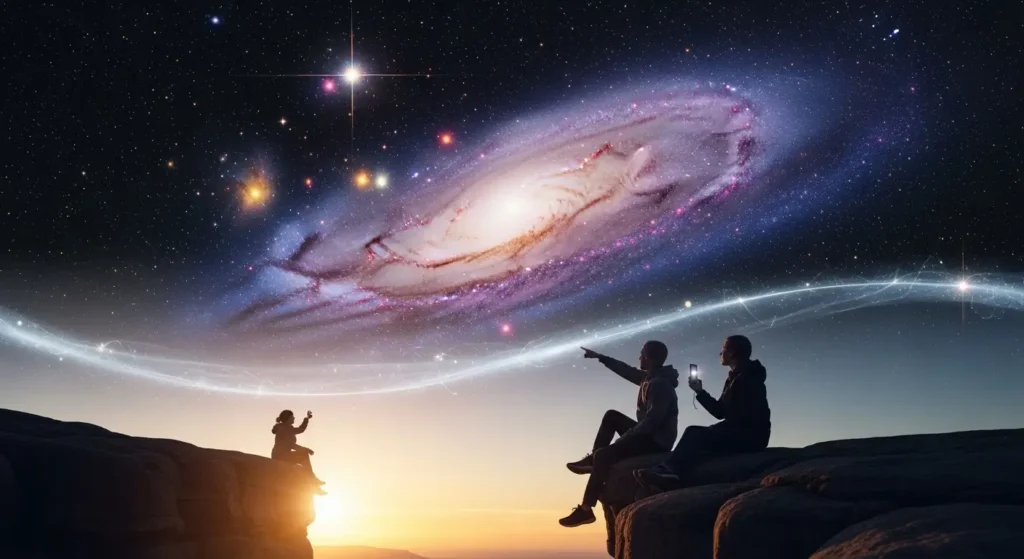
Stories have beginnings and ends.
The human mind requires narrative consistency.
An infinite universe defies the conventions of storytelling.
Thus, humans must have a conceptual end.
The need for narrative comfort informs our understanding of the universe.
Read more: Explore The Multiverse Of Your Mind
What does the Endless Universe imply?
The infinite universe defies human significance.
Finite boundaries are reassuring about significance.
So, the endless universe diminishes a sense of being at the center.
Therefore, opposition emerges in the psychological realm.
Acceptance involves humility.
Final Thoughts on Human Limitations
Humans venture into space with limited senses.
Technological advancements enhance sight but not understanding.
Therefore, limitations might be a function of human cognition.
The universe might be completely boundaryless.
Finally, curiosity fuels further exploration.



Leave a Reply